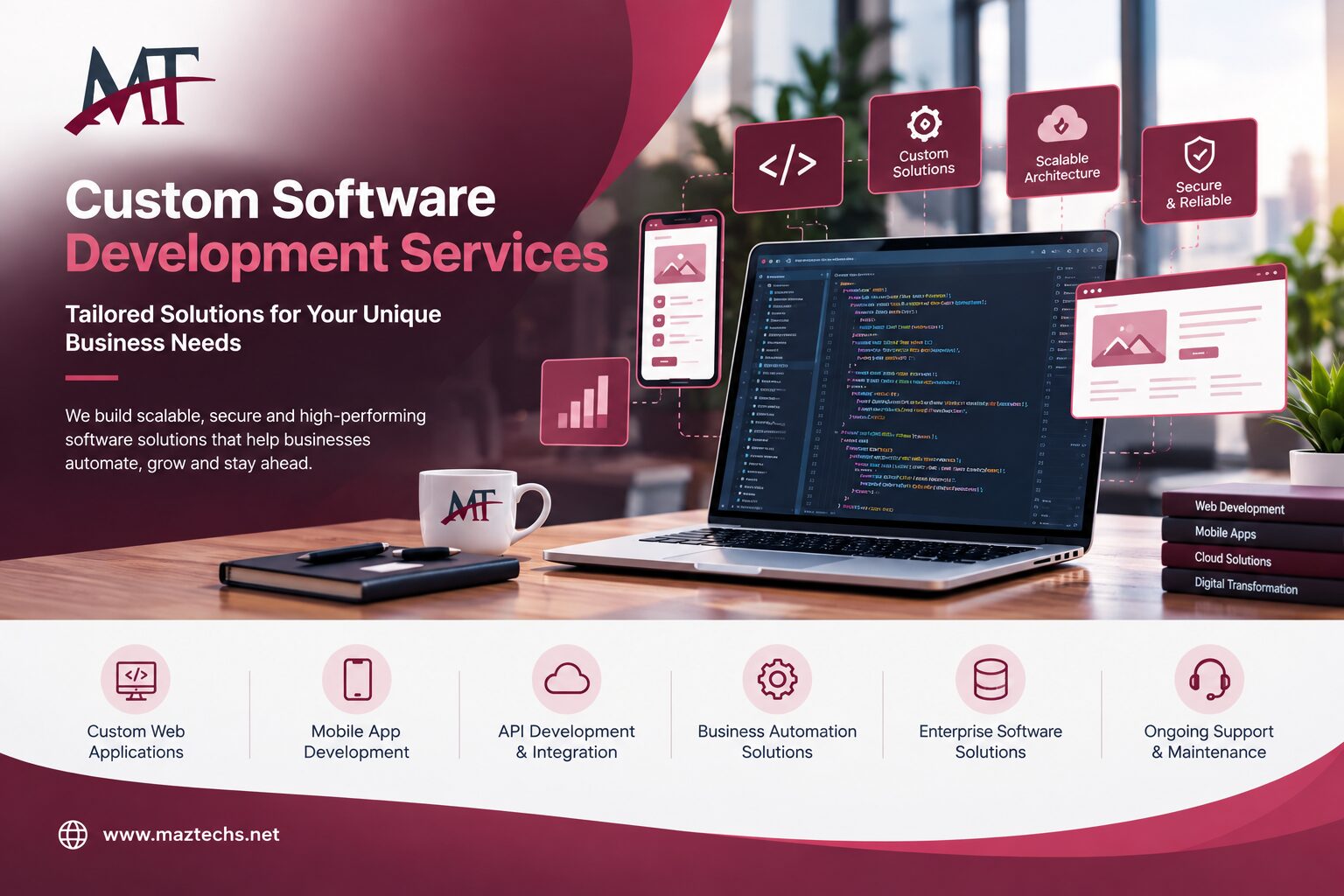
Custom Software Development Services: Building Scalable Solutions for Modern Businesses
In today’s competitive digital environment, businesses need more than off-the-shelf software to manage operations, serve customers, and support growth. While ready-made applications can be useful for general requirements, they may not always match the unique workflows, processes, and objectives of a growing organization.
This is where custom software development services can make a significant difference.
Custom software allows businesses to build digital solutions around their specific requirements instead of changing their business processes to fit a pre-built application. From internal management systems and business dashboards to customer-facing applications and API integrations, custom software can help organizations improve efficiency, automate repetitive tasks, and create better digital experiences.
What Is Custom Software Development?
Custom software development is the process of designing, developing, testing, deploying, and maintaining software specifically for the needs of a particular business or organization.
Unlike generic software products, custom applications are designed around the organization’s existing workflows, business objectives, users, and technical environment.
A custom software solution may include:
- Business management systems
- Customer relationship management platforms
- Enterprise applications
- Internal dashboards
- Inventory management systems
- Financial management software
- Custom web applications
- Mobile applications
- API integrations
- Workflow automation systems
- Data analytics and reporting platforms
- AI-powered business applications
The objective is not simply to create software, but to develop a solution that solves specific business problems and can evolve as the organization grows.
Why Are Businesses Investing in Custom Software Development Services?
Every business operates differently. Two companies in the same industry may have completely different workflows, customer requirements, reporting structures, and operational challenges.
Generic software can sometimes force businesses to adapt their processes to the limitations of the application.
Custom software takes the opposite approach.
Instead of asking, “How can our business adapt to this software?” organizations can ask, “What software does our business actually need?”
This approach can provide several important advantages.
1. Software Designed Around Your Business
One of the biggest advantages of custom software development is flexibility.
A custom application can be designed according to your organization’s processes, users, permissions, reporting requirements, and operational objectives.
For example, a company may need a system that combines:
- Employee management
- Customer records
- Sales tracking
- Inventory
- Invoicing
- Reporting
- Notifications
- Management dashboards
Rather than using multiple disconnected applications, a customized platform can bring these functions together into one integrated environment.
2. Improved Business Efficiency
Manual processes can consume significant amounts of time.
Employees may spend hours transferring information between spreadsheets, sending repetitive emails, preparing reports, or entering the same data into multiple systems.
Custom software can automate many of these repetitive activities.
For example, a business application can automatically:
- Generate reports
- Send notifications
- Assign tasks
- Update records
- Calculate business metrics
- Synchronize information
- Generate invoices
- Track customer interactions
- Trigger workflow approvals
Automation allows employees to spend more time on activities that require human decision-making and less time on repetitive administrative work.
3. Better Integration With Existing Systems
Businesses often use multiple software platforms.
A company might use accounting software, CRM software, an e-commerce platform, payment gateways, communication tools, analytics systems, and internal databases.
When these systems operate independently, employees may have to manually move information between them.
Custom software development can help connect different platforms through APIs and integrations.
For example:
Website → CRM → Payment Gateway → Accounting System → Reporting Dashboard
A properly integrated technology ecosystem can reduce duplicate data entry and provide businesses with a more consistent flow of information.
4. Scalability for Future Growth
Software should not only solve today’s problems. It should also support tomorrow’s requirements.
A business may begin with a relatively simple application and later require additional users, new modules, integrations, reporting capabilities, or mobile access.
A scalable custom software architecture can make it easier to introduce new functionality as the organization grows.
Businesses can potentially expand their systems with features such as:
- New user roles
- Additional departments
- Advanced reporting
- Mobile applications
- Third-party integrations
- AI capabilities
- Automated workflows
- Multi-location support
- Advanced analytics
This makes scalability an important consideration when selecting a software development approach.
5. Enhanced Data Management
Data has become one of the most valuable resources for modern businesses.
However, data becomes much more useful when it is properly collected, organized, analyzed, and presented.
Custom software can centralize business information and provide management with dashboards and reports that make important information easier to understand.
For example, management may want to monitor:
- Revenue
- Customer acquisition
- Sales performance
- Employee productivity
- Operational costs
- Inventory levels
- Customer retention
- Website activity
Instead of manually compiling information from multiple sources, a customized reporting system can provide decision-makers with a centralized view of business performance.
6. Improved Security and Access Control
Different employees require access to different information.
A custom application can be designed with role-based access controls that determine what individual users can view, create, edit, or manage.
For example:
Administrator → Full system access
Manager → Departmental reports and management features
Employee → Assigned operational features
Client → Customer-facing information
This type of structured access can help businesses manage sensitive information more effectively.
Security should be considered throughout the software development lifecycle rather than added only after an application has been completed.
7. Better Customer Experiences
Custom software is not limited to internal business applications.
Organizations can also use custom development to create better experiences for their customers.
Examples include:
- Customer portals
- Booking systems
- E-commerce platforms
- Mobile applications
- Self-service platforms
- Online payment systems
- Support portals
- Personalized dashboards
When customers can quickly access information and complete tasks through a well-designed digital platform, businesses can create a more convenient and professional customer experience.
What Types of Businesses Can Benefit From Custom Software?
Custom software development can be useful across many industries.
Financial Services
Financial organizations may require secure systems for customer management, reporting, transaction processing, analytics, and workflow automation.
Healthcare
Healthcare organizations can benefit from customized solutions for appointments, patient management, reporting, administration, and communication.
Retail and E-Commerce
Retail businesses can use custom applications for inventory management, order processing, customer management, payments, and business analytics.
Construction
Construction companies can use software to manage projects, estimates, employees, suppliers, documentation, budgets, and progress reporting.
Logistics
Logistics companies can develop customized platforms for shipment management, tracking, scheduling, fleet operations, and reporting.
Professional Services
Consulting firms, agencies, and service providers can use custom systems to manage clients, projects, invoices, employees, documents, and workflows.
The key consideration is not the industry itself but whether the business has unique processes or operational challenges that existing software cannot effectively address.
Custom Software Development vs. Off-the-Shelf Software
Both approaches can be useful, depending on the requirements of the business.
| Factor | Custom Software | Off-the-Shelf Software |
| Business-specific functionality | High | Limited |
| Flexibility | High | Usually limited |
| Custom integrations | High | Depends on provider |
| Scalability | Can be designed for growth | Depends on product |
| Initial investment | Usually higher | Usually lower |
| Development time | Longer | Faster |
| Control | Greater | Limited |
| Custom workflows | Strong | May require compromises |
Off-the-shelf software can be a practical option when a business has standard requirements.
Custom software becomes more attractive when the organization has specialized workflows, complex integrations, unique requirements, or long-term scalability goals.
How Does the Custom Software Development Process Work?
A professional software development project generally involves multiple stages.
1. Requirement Analysis
The first step is understanding the business problem.
Developers and stakeholders identify:
- Business objectives
- Target users
- Required features
- Existing systems
- Technical requirements
- Security requirements
- Integration requirements
- Expected future growth
Strong requirements analysis helps establish a clear direction before development begins.
2. Planning and Architecture
The development team then determines how the system should be structured.
This may include selecting:
- Programming technologies
- Databases
- Application architecture
- Hosting infrastructure
- APIs
- Security mechanisms
- Third-party services
Good architecture can make a major difference in the maintainability and scalability of a software product.
3. UI/UX Design
The user interface and user experience are designed before or alongside development.
The objective is to make the application intuitive, accessible, and efficient for its intended users.
A technically powerful application can still fail if users find it difficult to navigate.
4. Software Development
Developers build the application according to the approved requirements and architecture.
Depending on the project, this may involve:
- Front-end development
- Back-end development
- Database development
- API development
- Mobile development
- Cloud integration
- Third-party integrations
- Automation
- AI functionality
5. Testing and Quality Assurance
Before launch, the software should be tested thoroughly.
Testing can identify:
- Functional problems
- Security vulnerabilities
- Performance issues
- Compatibility problems
- Usability issues
- Integration errors
Quality assurance helps ensure that the final application performs as expected.
6. Deployment
Once the software has passed testing, it can be deployed to the appropriate production environment.
This may involve cloud infrastructure, dedicated servers, app stores, hosting platforms, or private business networks.
7. Maintenance and Continuous Improvement
Software development does not necessarily end at launch.
Businesses may require ongoing:
- Security updates
- Bug fixes
- Performance optimization
- Feature enhancements
- Technical support
- Third-party integration updates
- Infrastructure management
Continuous maintenance helps keep the software useful as business and technology requirements evolve.
Why Choose MazTechs for Software Development?
MazTechs provides software development solutions designed around the specific requirements of modern businesses.
Our approach combines business understanding, technical expertise, scalable development practices, and modern technologies to help organizations transform their ideas and operational requirements into practical digital solutions.
Our software development capabilities include:
- Custom software development
- Web application development
- Mobile application development
- Enterprise software solutions
- API development and integration
- Internal tools and dashboards
- Database development
- Business automation
- Software maintenance and support
- AI-powered software solutions
Whether you need an internal business application, a customer-facing platform, a management dashboard, or an integrated software ecosystem, the right development strategy can help turn your requirements into a scalable digital solution.